


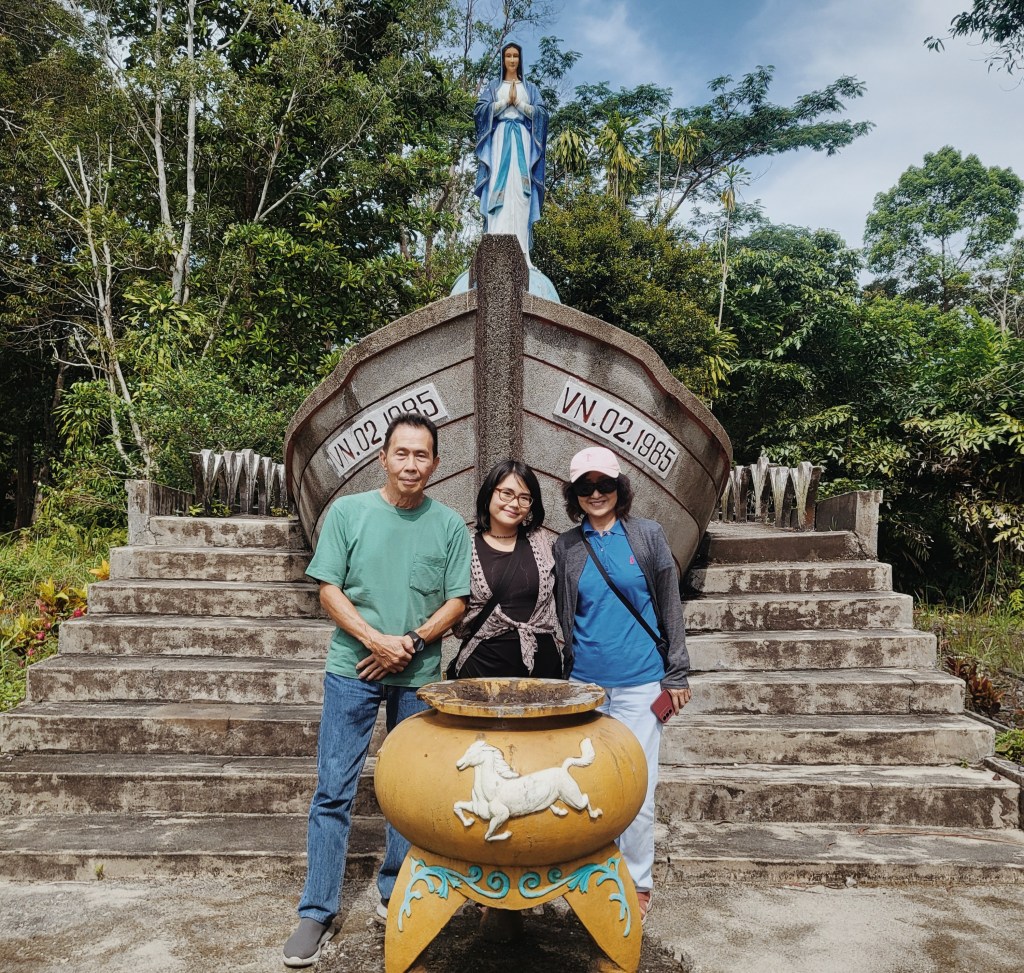
My parents & I @ in front of the Vietnamese refugee boat statue –
Too bad our childhood memories couldn’t be revived just as we wished. Because if they could, there is one that I specifically want to recall. I spent my early years (mainly from 0-3 years old) on Galang, a small island between the Riau archipelago in a Vietnamese refugee camp.

The aftermath of the Vietnam War that ended in 1975 still spiralled until the late 80s, which mainly led the southern Vietnamese to flee their country to avoid persecution. Some of them fled in the hope of finding a better life. They sailed their boats en masse and ended up after sometime on new shores, hence Indonesia’s shore.

With the aid from the United Nation, an international team was set up on Galang island to camp these Vietnamese refugees. Therefore, my parents as parts of this team worked there. And they took me, since I couldn’t be left alone at home as a baby nor was there a daycare available in a small town where I grew up partially.

I have heard these stories since I was a child. How I was painted by a talented Vietnamese refugee. How my parents’ boss was the first person who watched my first step in the dining room. How I made international friends in the camp (who knew I was a social baby, ey~).
But these memories didn’t stay. And never have I ever visited the island again as an adult. So, during my last visit to Indonesia with hubby, my parents had the idea for us to visit the island again, rekindling my childhood and their working era memories there as well as introducing a new world to hubby. Instead of two, we would kill three birds at the same time. Yay!

Our trip to the island was short and not complicated. Apparently the easiest way to go to Galang is just by ferry to Batam island, which is connected by the bridge to Galang. We took the 8 AM ferry from Tanjung Pinang to Batam for an hour. And then, a driver already waited for us, ready to take us to Galang.
Along the way my parents reminisced about the roads to go there. Our driver updated us about the latest situations. Once we were near the destination, he told us how haunted the area is. He said there shall be no visitors allowed in the area after 6 PM. Note, if you grow up in Indonesia, you are used to hearing some local ghost stories. And I totally forgot how chilly that could be.

Anyhow, we finally arrived at the camp. After we parked, I stumbled upon an unused building across the parking lot which seemed to be an office back then. It was heartbreaking to see how it is now. But at the same time it was intriguing. Just imagine how it was in its prime time. Moving on, I walked towards a decent building which is a museum.

The museum itself is by all means not a fancy or an interactive one. But, it documented how the Vietnamese came to us and how the camp used to be until it was disbanded in 1994, where the camp already served its purpose and all the refugees in the end found their home worldwide.


I asked my parents whether it was a happy ending for each of them, meaning that all finally found a permanent place to call home. My parents only said that the international quota for their potential home abroad was full. It was not an assuring answer. But, they couldn’t tell me more. So I moved on, with a question: why couldn’t Indonesia take even just one soul. Because we didn’t.
Funny to see how your parents were documented as well in the museum. I had to say I was proud of them serving fellow humans regardless of their different background. Humanity is what makes us human after all.


During our museum visit, a man came to my parents. He introduced himself as Samir (not his real name). My dad could recall him, but my mom blanked out. She forgot him. Regardless, boy was he so happy to see my parents. Samir was a local who had been living on the island. Back then, he was around 10 years old when the refugees arrived. He grew up with Vietnamese kids, resulting in his fluency in the language.

Samir works at the museum now. And what a coincidence since he accompanied another guests which was Mr. Suryo (not his real name) and his family, an administrator who was also my parents’ coworker. Their reunion was heartwarming. They haven’t met for 30 years. When they met, it was unplanned and just beautiful.

Together they caught up on what had been happening and I felt it cracked them, since a lot of things sadly have changed. Too many buildings have been destroyed, the barracks, the dining room, the office are just some. Many look nothing like before. Samir said when he thought about his childhood memories playing badminton with the Vietnamese kids in a sports hall, he cried. There was none anymore.

He took us to what now remains on the hood besides the museum. Together we visited the temple, the church, a boat statue, and also a Mother Mary statue. Even though a lot was not the same, some look better now. The road is renovated. The church is in a better shape. The big mother Mary and refugee boat statues look quite freshly made. And the temple has more decorations.


As we passed by the church, my dad told me how I was baptized here with their coworker, Uncle Jo, who acted as my godfather. I only saw him three times in life as far as I can recall, and I never talked to him properly. My parents gave me a golden cross necklace during this coming home visit. They said it is his gift for my baptism. Too bad Uncle Jo already passed since I really wanted to say thank you for his role and his gift to me.

As far as it goes for the buildings, my mom’s office was gone, so was my dad’s. They took time to say where their offices used to be since now they are covered in bushes. I wouldn’t have guessed there used to be offices if they didn’t tell me. It was that bad. As they looked deep into the bushes, I wondered what they thought. But more, I wanted to know how they feel.

In the end, we took time to take pictures as memories. This time as a group, also with Mr. Suryo and his family. Samir showed how his Tieng Viet, an official Vietnamese language, just flowed like water. He instructed us to say 1 2 3 in Tieng Viet or môt hai ba. But he said it in the correct tone of course. At least it sounded correct to us. Afterwards, my parents said goodbye to Mr. Suryo and family.
During our visit I saw some other visitors. They look at least Vietnamese to me. I asked Samir about their visit to the island after finding their forever home. From him, we know how they will come to the island time after time with their family and close relatives.
This place was after all a part of their home in life and critical in their journey to find a permanent one. Thank God for the happy second generation. But it is necessary for them to get a grasp about the hardship. Since some also didn’t make it and just passed during the journey, still on a boat, not seldom the whole family.

This island, especially this ex camp, is nowadays popular as Kampung Vietnam or Vietnam Village. It played an important part in one of the biggest southeast asian migration history. It holds a deep story for some.
And yet if you haven’t heard about it, it won’t mean a thing to you. Visually, it is not instagrammable. But, once you know its story, maybe now after reading this piece you might feel intrigued to witness a part of documented migrant history. Do let me know 🙂


 @globustrotterin
Leave a reply to helenclaratj Cancel reply